Instawork: Be your own boss
- 4.4
- Rating
- 1.00M
- Installs
- Free
- Price

 Analysis by App-foxy
I look at job apps differently from ordinary shopping or entertainment apps. When an app asks me to create a work profile, share personal details, and make decisions about shifts, trust matters as much as convenience. Instawork is a business app from Instawork that connects people with nearby work, shifts, and short-term gigs. I found its main idea easy to understand: instead of searching only for permanent employment, I can look for work that may last a few hours, several days, or a few months.
That flexibility is the reason I would consider using it, but it is also why I would not treat every opportunity casually. A shift affects my schedule, travel, income expectations, and reputation. The app can help organize that search, yet it does not remove the responsibility of checking each opportunity carefully. My overall impression is that Instawork is most useful when I want a practical way to explore temporary work while keeping control over which opportunities I pursue.
How Instawork fits into a careful job search
Instawork belongs to the business category and is free to download. It is rated for Everyone, which makes the app broadly accessible from an age-rating perspective, although the work itself may still have its own requirements. The app has been available since July 5, 2016, and its current version is 2.238.2. It supports devices running Android 7.0 or later, so people using older phones should check compatibility before planning around it.
You May Also Like

 Blood Strike: 2.5 Anniversary
Blood Strike’s Loadouts Turn Every Drop Into a Tactical Gamble
A close look at Blood Strike’s custom loadouts: how fast access to signature weapons reshapes its battle royale rhythm, rewards preparation, and narrows the gap between fights.

 Pandora - Music & Podcasts
Pandora’s Music Is Easy to Start, but Harder to Recover
Pandora’s strength is its low-effort path from a seed to a station. Its weak spot is how much confidence it asks you to place in connection, setup, and quiet recovery.

 8 Ball Pool
 Is Built on Rivalries, Rematches, and Routine
A close look at the rivalries, rematches, shared routines, and unanswered safety questions that turn a quick pool match into a persistent mobile community.

 Samsung Music
’s Quiet Strength Is Playing What You Already Own
Its reach comes less from spectacle than from dependable access to a personal library. That simplicity is both the app’s strongest retention engine and its ceiling.

 AccuWeather: Weather Radar
AccuWeather Review: A Quick, Clear Forecast for Everyday Decisions
For everyday plans, the best forecast is the one you can understand quickly. AccuWeather makes rain timing, radar, and local conditions easy to act on, with a few trade-offs.

 Hill Climb Racing
Why Hill Climb Racing Still Turns Crashes Into One More Run
A tiny car, a bumpy hill and one more upgrade: Hill Climb Racing keeps resurfacing because its simple chaos makes every near-miss feel personal.
More From Our News Desk



The app has built a sizable audience, with over one million installs, around 42 thousand ratings, and roughly 16 thousand written reviews. Its average rating is 4.3, which suggests that many users find the basic experience worthwhile, while still leaving room for the kind of mixed experiences I would expect from a marketplace where availability, location, employers, and individual expectations can vary.
What I like about the concept is that it does not force me to think of work as one fixed category. A person between jobs might use it to fill gaps in a calendar. Someone with changing responsibilities might prefer occasional shifts to a rigid weekly schedule. A worker who is considering a new type of role could use short assignments to learn what suits them before committing to a longer arrangement.
At the same time, I would not describe it as a replacement for a conventional job board in every situation. Traditional employment sites are usually better for comparing permanent positions, studying company backgrounds, reading detailed job descriptions, and following a longer hiring process. Instawork makes more sense when speed and flexibility matter more than building a long-term career plan through one application.
Trust starts before accepting a shift
My first practical rule would be to treat the profile-building stage as a work application, not as a casual sign-up. I would read every screen before submitting information and pay attention to which details are required, which are optional, and how each item is used in the context of finding work. A clear choice is more valuable than simply moving quickly through registration.
This is especially important because a work marketplace needs enough information to match people with opportunities, but users should still understand what they are sharing. I would avoid entering details that do not appear relevant to the work search, and I would review the account screens after setup rather than assuming the initial choices are permanent or obvious.
When an app involves employment, I also want to know who is responsible for the next step. Instawork can help present opportunities, but I would still distinguish between the platform, the business offering the shift, and any person supervising the work. That distinction affects whom I contact when instructions are unclear, a schedule changes, or the actual role does not match what I expected.
A useful habit is to save the important information about a shift before accepting it: location, start time, expected duration, role, dress requirements, and any instructions shown in the app. I would not rely on memory or assume that a short listing tells the whole story. This small step gives me something concrete to compare against later and reduces avoidable misunderstandings.
Controls I would check inside the account
The most important control is the ability to decide which opportunities I accept. I would use Instawork as a selection tool, not as a stream that dictates my schedule. Before committing, I would compare the shift with travel time, existing responsibilities, and the likelihood that I can arrive prepared. A shift that looks convenient on a screen may be poor value if reaching it takes too long or requires expensive transport.
I would also review notification settings and account choices as soon as I finish creating the profile. Work alerts can be useful when timing matters, but too many notifications can encourage rushed decisions. Keeping only the alerts that help me act, while silencing distractions, makes it easier to evaluate opportunities instead of responding automatically.
Another control is the decision to keep my profile current. If my availability, experience, or preferred work changes, I would update it rather than accepting assignments that no longer fit. An outdated profile can create the wrong expectations on both sides. This is one of the less obvious ways to protect my own time: accurate information reduces the number of unsuitable opportunities I need to sort through.
I would be careful with account access on shared devices. Since a work profile may contain personal and employment-related information, I would sign out when using a phone or tablet that other people can access. I would also avoid sending sensitive account details through informal messages simply because someone asks for them during a shift conversation. The safest choice is to use the app’s visible account and work flows whenever possible.
These are not glamorous features, but they make a real difference. The app’s value is not only in discovering work; it is in helping me make deliberate choices about availability, communication, and commitments. If I cannot understand or manage those choices, the convenience of finding a shift quickly becomes less meaningful.
Where personal information deserves extra attention
The most data-sensitive moment is the first profile setup. I would pause at every request for personal information and ask whether it directly supports eligibility, matching, scheduling, or communication. I would not assume that a field is harmless just because it appears in a familiar form. My approach would be simple: share what is necessary for the work process, understand the purpose of each request, and avoid treating the profile as a general-purpose identity record.
A second sensitive moment comes when I consider a specific opportunity. Location details can reveal where I am expected to be and when. That is useful for deciding whether a shift is practical, but it also means I should review the address and schedule before accepting. I would plan my route privately, avoid sharing unnecessary travel details, and make sure I know whether the location is a public business, a worksite, or another type of venue.
Communication is another point where I would stay alert. If a message asks me to move a conversation elsewhere, provide additional personal information, or pay for something before I can work, I would stop and verify the request through the clearest official route available. I would not let the urgency of a shift override basic caution. A legitimate opportunity should still be understandable enough for me to check what I am agreeing to.
I would also read the app’s privacy and account screens rather than relying on assumptions about data handling. The important questions for me are practical: what information is visible in my profile, what choices can I change, how can I manage communications, and what happens when I no longer want to use the account? I would look for answers inside the app and its linked policy pages before adding more information than I need.
My caution is not a criticism unique to Instawork. Any service that combines identity, location, scheduling, and work opportunities deserves careful use. The difference is that a job app can affect my income and professional reputation, so a small mistake has more consequences than an unwanted promotional notification.
A realistic way I would use it
Imagine that I have a week with several open days but do not want to commit to a permanent role yet. I would begin by setting aside a fixed amount of time to browse, rather than checking every new listing impulsively. I would filter my thinking by distance, schedule, role fit, and the amount of preparation required. Then I would shortlist only the shifts that I could realistically reach and complete.
Before accepting one, I would write down the start time, location, role expectations, and any clothing or equipment instructions. I would check the route at the time I would actually travel, not only during a quiet part of the day. If the shift required an early arrival, I would consider whether transport was reliable enough to protect my attendance record.
After accepting, I would keep the app available for relevant updates but avoid changing my plans around vague possibilities. If another opportunity appeared, I would compare it with the commitment already made instead of treating both as interchangeable. This is a key trade-off: flexible work can create more options, but accepting too many options at once can damage reliability.
After the shift, I would record what happened while the details were fresh. Did the work match the description? Was the location easy to find? Were the instructions clear? Did the timing fit my life? These notes would help me make better choices later and would be more useful than judging an opportunity only by how attractive it looked before I arrived.
Who benefits most, and who should look elsewhere
I think Instawork is a strong fit for people who value short-term flexibility and can make quick but careful decisions. It may suit someone building a schedule around school, family duties, another job, or a transition between roles. It can also help a person test different kinds of work without immediately making a long commitment.
It is less suitable for someone who needs guaranteed hours, predictable weekly income, or a single employer relationship. If my budget depended on receiving a fixed number of shifts, I would use the app only as one part of a broader plan. I would not assume that the presence of listings means the exact work I want will always be available when I need it.
People who dislike last-minute changes or who have limited transport options should be especially selective. A nearby listing is not automatically convenient if the route is difficult, the start time is unforgiving, or the role requires preparation that was not obvious at first glance. In those cases, a local staffing agency or a direct employer may offer clearer expectations and a more stable relationship.
For long-term professional development, I would compare Instawork with conventional job boards and company career pages. Those alternatives may provide more room to research an employer, follow a formal application, and pursue a permanent position. Instawork’s advantage is the shorter path from browsing to a possible shift, not necessarily the depth of information associated with a traditional hiring process.
Friction I would not ignore
The biggest limitation is the gap between discovering a shift and knowing whether it is genuinely right for me. A compact listing can never capture every detail of a workplace, and temporary assignments leave less time to correct a misunderstanding. I would therefore resist the temptation to judge an opportunity by its title or location alone.
There is also a personal cost to flexibility. I may need to check the app regularly, keep my availability accurate, prepare for different workplaces, and make decisions without the comfort of a long hiring conversation. That can be worthwhile for someone who wants control over when to work, but tiring for someone who prefers a predictable routine.
I would also keep expectations realistic about the phrase “be your own boss.” Choosing shifts gives me more control over my schedule, but it does not mean that every aspect of the work is independent. I still need to follow the workplace’s instructions, arrive on time, meet the role’s expectations, and communicate responsibly. The app can support independence in scheduling without turning every assignment into a fully autonomous business.
For that reason, I would use the app with a simple personal checklist. I would confirm the work, check the route, understand the time commitment, review what information I am sharing, and keep a record of important communications. This takes a few extra minutes, but it protects the main benefit of the platform: flexibility that remains under my control.
My cautious verdict
I would recommend Instawork to a friend who wants to explore nearby short-term work and is comfortable managing commitments independently. The free price lowers the barrier to trying it, and its focus on shifts and gigs makes it more relevant than a standard job board for people who do not want to begin with a permanent position. Its broad audience and 4.3 average rating show that the approach has found real appeal, though I would still judge each opportunity on its own terms.
My recommendation comes with boundaries. I would not use it as my only income plan without first learning how well the available work fits my location, schedule, and skills. I would not share more personal information than the process requires, and I would review account controls, notifications, and privacy choices instead of clicking through them automatically.
In the end, Instawork works best as a tool for informed choice. It can open a door to flexible work, but I still decide which doors are worth entering. If I need permanent stability, detailed employer research, or guaranteed hours, I would look at other routes first. If I need a practical way to find occasional work while keeping a close eye on my commitments and personal information, Instawork is worth trying carefully.
That balance is what makes the app useful to me. It does not eliminate the uncertainty of temporary work, and it should not be treated as a promise of effortless income. Used thoughtfully, however, it can turn an open schedule into a more organized search for suitable opportunities while leaving the final decision in my hands.
FAQs for Instawork: Be your own boss
01What is Instawork and how does it work?
Instawork is a platform that connects businesses with skilled hourly workers, allowing you to find flexible job opportunities in various industries such as hospitality, warehouse, and retail. Users can browse available shifts, apply for jobs, and get paid directly through the app. It's designed to give workers the freedom to choose when and where they work.
02Is Instawork available in my area?
Instawork is expanding rapidly across the United States, primarily in urban and suburban areas. To find out if it's available near you, you can download the app and enter your location. The app will show you a list of available jobs in your vicinity, if there are any. Availability may vary based on demand and local partnerships.
03How do I get paid through Instawork?
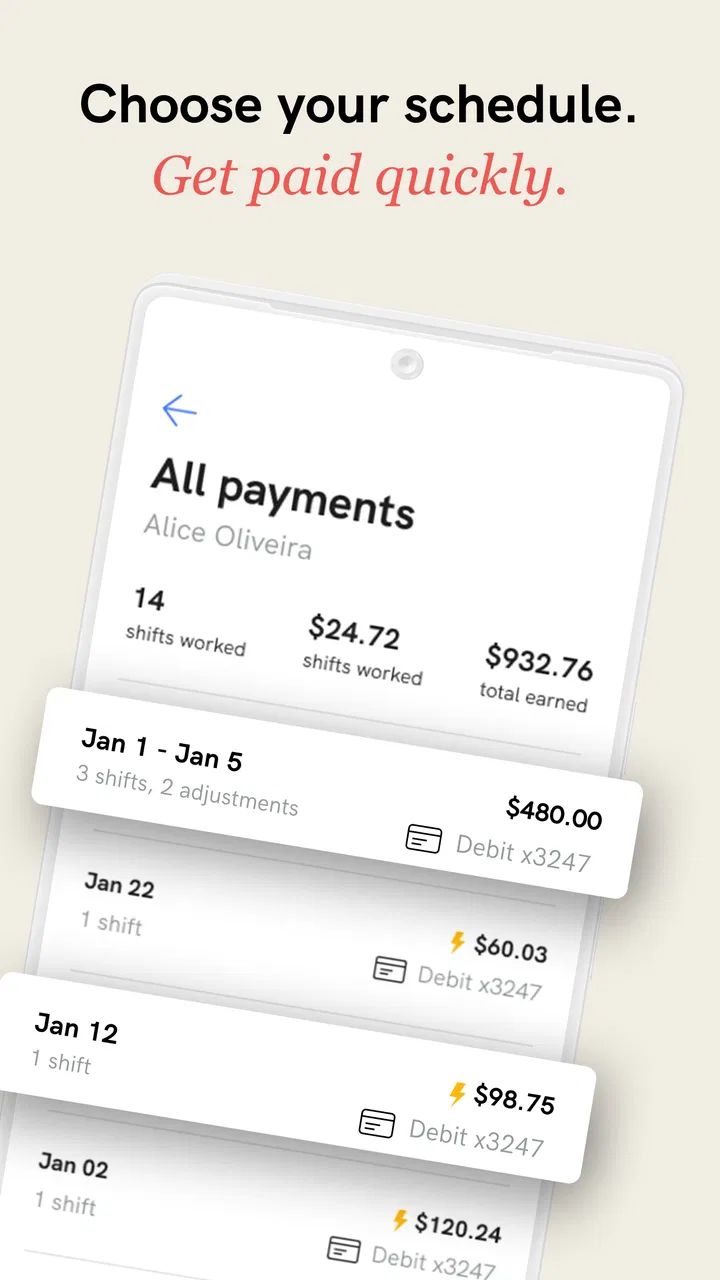
Instawork offers direct deposit payments, allowing you to receive your earnings quickly and securely. Payments are typically processed within a few days after completing a shift. You’ll need to provide your banking information in the app to set up this feature. Details about payment frequency and any available bonuses are also provided in the app.
04What are the requirements to join Instawork?
To join Instawork, you need to be at least 18 years old and have the legal right to work in the United States. You must also have a smartphone to use the app and a reliable means of transportation to get to job sites. Some jobs may have additional requirements, such as specific certifications or experience.
05How does Instawork ensure the quality and safety of job postings?
Instawork carefully vets businesses before allowing them to post jobs on the platform, ensuring that they meet certain standards for safety and reliability. Additionally, workers can rate and review their job experiences, which helps maintain a high quality of job postings. Instawork also provides support for any issues that may arise during a shift.
Pros
- Flexible work hours allow for a custom schedule.
- Wide range of job opportunities available.
- User-friendly interface for easy navigation.
- Instant payment options enhance convenience.
- Helps build a professional network.
Cons
- Limited job availability in some regions.
- App notifications can be overwhelming.
- Occasional technical glitches reported.
- Some jobs require specific skills or experience.
- High competition for popular shifts.

Instawork: Be your own boss
Gallery